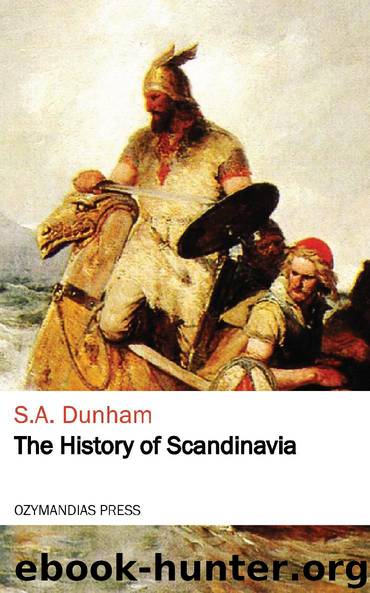
The History of Scandinavia by S.A. Dunham
Author:S.A. Dunham
Language: eng
Format: epub
Publisher: Ozymandias Press
Fate had not yet done its worst on the offspring of the Norwegian monarch. His son Gudred perished at sea. And when he resigned his imperial dignity in favour of his beloved Eric, other tragedies might have been foreseen—if not in his lifetime, immediately after his death. The elevation of Eric was opposed, among others, by Halfdan the Black, who, also, assumed the title of monarch. Olaf, brother of the murdered Biorn, who had succeeded that prince in the government of Westfold, did the same. In two years Halfdan was removed by poison,—the deed, as was commonly reported, of Gunhilda. Harald was little moved by these atrocities. So long as his favourite son enjoyed life and empire, he cared little for the rest. But his own days were hastening to an end. When he resigned his sceptre to his son Eric, he was eighty years of age. In two or three years after that event,—in the year 934, or, according to others, 936—he paid the debt of nature. The place of his interment was one of his manors in Drontheim. Near the spot, a magnificent heathen temple was erected, which was standing in the days of Snorro.
To dwell on the character of this monarch, after the ample relation which we have given of his deeds, would be useless. With the exception of his martial prowess, of his enterprising spirit, of his unwearied activity, we see little to praise in him. His numerous adulteries—his feebleness soon after he had passed the meridian of life—his blind policy—have not often been exceeded. Much praise has been lavished on him for his extirpation of piracy; but he is entitled to little. So long as his own shores were not visited by the marauders, he cared not what depredations were committed on others. His chiefs, his very sons, followed piracy as a profession, not merely with his sanction, but at his express command. He has been called the friend of the peasants, or rather of the humble allodial proprietors; but did not policy make him so? If they were plundered by those in authority, could they furnish the new contributions which, as the first of Norway’s feudal sovereigns, he exacted from them? Then, as to his boasted administration of the laws, nothing is more certain than their perpetual neglect: after he had passed his fortieth year, they were inoperative,—despised by his own sons, evaded by the jarls. Nor, however brilliant his conquests, can he be called the founder of the Norwegian monarchy. If he destroyed many tyrants, he replaced them by greater: if he united many independent states into one empire, by his own deliberate act he broke that empire into fragments, and restored the anarchy which he had laboured to destroy. Widely different is his character before and after he had attained the meridian of life. It seemed as if he were led by some evil spirit to undo, in the latter period, all that he had done in the former. But he had
Download
This site does not store any files on its server. We only index and link to content provided by other sites. Please contact the content providers to delete copyright contents if any and email us, we'll remove relevant links or contents immediately.
| Africa | Americas |
| Arctic & Antarctica | Asia |
| Australia & Oceania | Europe |
| Middle East | Russia |
| United States | World |
| Ancient Civilizations | Military |
| Historical Study & Educational Resources |
Room 212 by Kate Stewart(5119)
The Crown by Robert Lacey(4814)
Endurance: Shackleton's Incredible Voyage by Alfred Lansing(4780)
The Iron Duke by The Iron Duke(4354)
The Rape of Nanking by Iris Chang(4211)
Joan of Arc by Mary Gordon(4109)
Killing England by Bill O'Reilly(4001)
Say Nothing by Patrick Radden Keefe(3984)
I'll Give You the Sun by Jandy Nelson(3446)
Shadow of Night by Deborah Harkness(3367)
Hitler's Monsters by Eric Kurlander(3341)
Mary, Queen of Scots, and the Murder of Lord Darnley by Alison Weir(3210)
Blood and Sand by Alex Von Tunzelmann(3203)
Eleanor & Park by Rainbow Rowell(3171)
Darkest Hour by Anthony McCarten(3129)
Margaret Thatcher: The Autobiography by Thatcher Margaret(3081)
Book of Life by Deborah Harkness(2938)
Red Famine: Stalin's War on Ukraine by Anne Applebaum(2932)
The One Memory of Flora Banks by Emily Barr(2863)
